
In 2022, Drs. Spencer Anderson, Hunter Charles Spitz , Timothy Charles Frommeyer, and Sunishka M Wimalawansa published the case of a man in his seventies who injured his right forearm during a work accident. Despite what the authors describe as “gross functional limitation,” he did not seek medical attention for several months. Eventually he felt a new “pop,” followed by swelling and pain, and finally went to a doctor.
Upon examination, physicians discovered the man had what doctors call a malunion of a Galeazzi fracture-dislocation, a form of fracture discovered nearly two centuries ago where the radius had healed at an abnormal angle and had shortened, while the joint between the radius and ulna at the wrist remained chronically dislocated. He had severe limitations in moving his wrist and rotating his forearm.
The man’s body had tried to heal itself and tried to adapt. But the bones healed in the wrong position.
Why the man did not seek treatment is not known. Many people have many reasons, such as cost, fear of lost wages, or just an aversion to medical care. But it is not hard to see the argument in favor of repairing a physical, obviously broken bone properly.
Also in 2022, a 14-year-old female victim of sexual assault was taken to a Child Advocacy Center in central Indiana after police responded to a call from a school counselor who heard the girl’s disclosure. At the CAC, the multidisciplinary team observed her forensic interview as she disclosed at least five separate sexual assaults from her grandfather and months of severe mental strain and abuse by her grandmother, who knew of the assaults.
The girl’s parents were in shock. Investigators charged the grandfather and grandmother, who were later sentenced to years in prison for their crimes. The CAC provided an expedited referral to mental health counseling, but, like the man with the arm fracture, the family never fully sought care for reasons that remain a mystery to all but the family.
Mental health care is often difficult to find. All 92 Indiana counties contain federally designated mental-health workforce shortage areas (PDF). Mental health care also remains stigmatized, expensive like all medical care in the U.S., and can be time-consuming.
Mapping trauma in the brain through qEEG
Like the man whose arm attempted to heal, albeit poorly, the human brain also works to adapt and heal itself after an injury. Injuries could be a knock against the head or, trauma, anger, and grief.
“Grief is a normal protective process,” says Dr. Lisa Shulman. “This process is an evolutionary adaptation to promote survival in the face of emotional trauma.” Dr. Shulman is the director of the University of Maryland Parkinson’s Disease and Movement Disorders Center and is The Rosalyn Newman Distinguished Scholar in Parkinson’s Disease. She has also served as treasurer for the American Academy of Neurology.
In the last decade, neurologists and scientists have begun to understand how grief may be akin to a form of “brain damage” and the outflow of the body’s natural attempts at self-regulating and healing. Grief also comes with physical side effects, such as changes in memory, behavior, sleep, and body function, all affecting the immune system as well as the heart.
One way we know this and can measure brain activity over time is through quantitative electroencephalography, or qEEG, to map portions of the brain. Dr. Jane Yip is the founder and director of Indiana Brain Mapping, a Carmel-based practice that uses qEEG. “[Traditional] EEG looks at electrical patterns in the brain. Cells produce electricity like an electric eel,” says Dr. Yip. “That is the result of cellular function and the brain coordinating information. qEEG is a 3D take on the centers of the brain. It looks at more coordinates across more than a single flat line.”
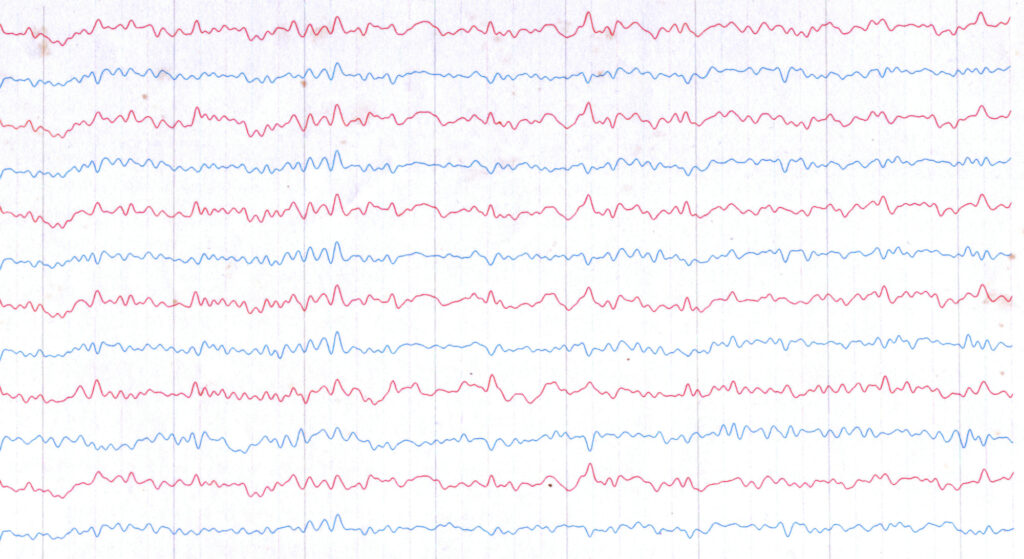
To demonstrate, Dr. Yip shares a screen with her own brain mapped. A series of about a dozen colorful lines representing electrical activity stretch down the screen. Each line corresponds to a part of the brain. “qEEG can measure addiction and reward centers, mood, default mode (inner recovery), executive function, memory, salience (decision making), and more,” she says. “An EEG gives you a single line, but qEEG gives you over a dozen.”
“Not all trauma is the same. There is peer-reviewed research on neglect showing that brain matter shrinks. In some of the more severe cases where children have also been drug-exposed such as in the womb. It’s not that they cannot change, but the process is more prolonged.”
“We’ve seen children who have experienced trauma—physical abuse, sexual abuse—whose brain patterns have normalized with medication, therapy, a stable home environment, and support from CASA volunteers, court workers, and social workers. I want to advocate for this because they can improve. Even saving one life has a ripple effect across society,” says Dr. Yip.
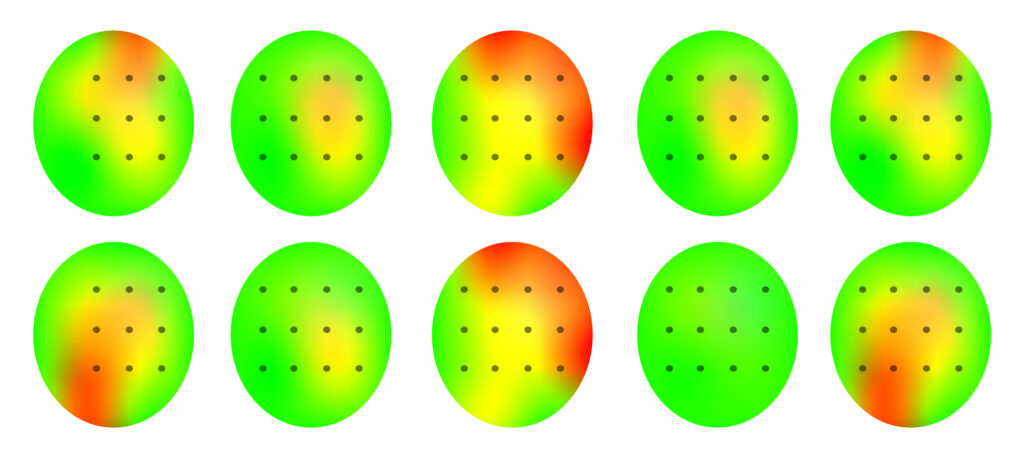
Dr. Yip shows another screen as part of her ongoing research comparing a control group to her own brain. The image shows 10 circles representing a head, all brightly colored green with occasional splotches of yellow hues. On the right, for her brain, a similar set of circles appear but different locations of soft yellow gradients and even a small spot of red appear. “Green is normal control,” she says. Red indicates higher dis-coordinated energy. The maps, she says, can be used to understand everything from ADHD, PTSD, impacts of medication, sleep deprivation, depression, prenatal exposure to drugs, autism, and more.
Comparing trauma and grief to a form of brain injury
Dr. Yip is quick to clarify at all points that qEEG can’t be used to diagnose anyone with anything. She is not a psychologist or a physician. Her PhD is in neuropharmacology, and her work as a neuroscientist is the result of decades of research on autism, trauma, and behavior. “Certainly we can’t diagnose, but we can look at patterns of qEEG scans and tell how different they are based on the pattern we see.”
Asked if a qEEG might reveal what happened to someone who suffered extreme trauma, grief, or mental strain she adds, “I don’t think we could deduce what had happened [from a scan]. The qEEG would also be different from a brain injury.” In this regard, contemporary medical testing with a qEEG can’t make the case that grief is akin to a form of brain damage like being struck against the head with an object. But the scans do show that a dis-regulated, uncoordinated brain firing off in uncontrollable ways speaks to the complexities of our minds.
However, like how an X-Ray can show the result of some kind of bone injury but not necessarily how the injury occurred, qEEG can be used as a neurological baseline for further discussion about treatment and care.
Why can two children experience apparently similar abuse and have radically different outcomes?
Child Advocacy Center staff often see families forego mental health care after confirmed cases of severe abuse and trauma. Even with expedited referrals, access to telehealth, and sometimes steeply discounted or covered services, physical examinations are more often requested. This despite the majority of children who receive physical medical examinations are quite healthy and resilient. Indeed, the physical examinations are often more for the parent’s peace of mind. Mental health care, however, lags. The reasons may have to do with time, or travel, or stigma, or some other combination of factors. But Dr. Yip’s work reveals why this is probably a harmful decision.
“Each person processes trauma differently. Area 13 [of the brain] coordinates body to mind. There seems to be a disruption in how you feel in your body after trauma,” she says. “I’ve not reported on this yet. But I seem to see changes with Area 13 of the brain in sexual abuse victims.” She clarifies, “I need to do a study with a large cohort, something I’d love to do. We have the subjects, just no funders.”
Still, her early research reveals outcomes can be extremely different between people, even when they suffer similar kinds of abuse. We see this most starkly, she says, “In a loving family where a child is given validation versus not.”
“The worst-case scenario,” she recalls of one person, “Is there’s no validation whatsoever.” She recall “This] person went within herself, suffered profound depression and then personality splits. Split personalities is a controversial topic, but in this case the treating psychologist mentioned it, and the patient split personalities to help them adapt. A lot of that depends on how they understand what happens and what help is given to them.”
In another case, she adds, “We mapped one young lady who was trafficked and rescued, and what I’ve seen is that—she’s not doing well. She has completely dissociated and can’t hold conversations.” Dissociation refers to an involuntary mental process where a person disconnects from their sense of self, surroundings, or reality, often as a response to trauma. Dr. Yip adds that for a victim to survive trafficking only to be largely forgotten or left to ‘heal on their own’ is deeply troubling. “This is society’s responsibility to take care of individuals like that. We need a lot of provisions for that,” says Dr. Yip. Victims who dissociate suffer significant loss of income, struggle to integrate into communities, and present a whole new generation-long set of challenges for themselves, their family, and society.
“Unfortunately, there is a perception about mental health,” says Dr. Yip. “You can’t see your brain. But when you can’t remember things, get things done, or if you fly off the handle, what about the costs that come with that over a lifetime?
Dr. Yip’s work mapping brains with qEEG is helping therapists and mental health providers track patient’s progress over time. But is it possible a person can participate in mental health therapies and still see no progress or positive change? She quips, “Therapists often joke, ‘How many therapists does it take to change a light bulb? As many as it needs if the light bulb agrees to be changed’.”
For many, she says, “Lack of will, not lack of skill, can mean some patients do not see progress after a year of therapy or medications.”
Still, mental health therapies are critical for recovery, especially in child victims of abuse and sexual assault that have a long lifetime ahead. The unseen burden can be immense. Dr. Yip adds, “Think of a broken leg and you keep walking. What’s going to happen to you? A broken brain is even more profound.”